
What Is the MAH-CET? Eligibility, Syllabus and Fees, Registration, Result Date, Last Date, Application Fees, Course Fees 2027

What Is the MAH-CET? Eligibility, Syllabus and Fees 2027
Hey there, future management leader! If you are dreaming of securing a seat in Maharashtra’s most prestigious and high-ROI business schools like JBIMS, SIMSREE, or PUMBA, cracking the MAH-CET is your golden ticket.
The Maharashtra Master of Business Administration Common Entrance Test (MAH MBA CET) is a highly popular, state-level entrance exam. What makes it a favorite among MBA aspirants? It has no negative marking! As you gear up for the 2027 admission cycle, having a clear roadmap is absolutely crucial. In this comprehensive, EEAT-compliant guide, we will answer the ultimate question: What Is the MAH-CET? Eligibility, Syllabus and Fees, Registration, Result Date, Last Date, application Fees, Course Fees 2027. Let’s dive in!
What is the MAH-CET Exam?
The MAH MBA CET is a computer-based, state-level entrance examination conducted by the State Common Entrance Test Cell, Government of Maharashtra. It serves as the primary gateway for admission into the first year of full-time MBA/MMS programs at over 300 management institutes in Maharashtra, including the highly coveted JBIMS Mumbai.
The exam is designed to evaluate a candidate’s logical reasoning, quantitative aptitude, verbal ability, and abstract reasoning. It is heavily focused on speed, requiring candidates to solve 200 questions in just 150 minutes.
MAH-CET 2027 Exam Pattern
Before we jump into the syllabus and fees, it is crucial to understand the structure of the exam. Here is a detailed table breaking down the MAH-CET 2027 exam pattern:
| Section | Number of Questions | Time Allotted | Marking Scheme |
|---|---|---|---|
| Logical Reasoning | 75 | 150 Minutes (Combined) | +1 for correct, No negative marking |
| Abstract Reasoning | 25 | 150 Minutes (Combined) | +1 for correct, No negative marking |
| Quantitative Aptitude | 50 | 150 Minutes (Combined) | +1 for correct, No negative marking |
| Verbal Ability & Reading Comprehension | 50 | 150 Minutes (Combined) | +1 for correct, No negative marking |
| Total | 200 Questions | 150 Minutes (2.5 Hours) | Total Marks: 200 |
Crucial Note: There are no sectional time limits in MAH-CET. You can switch between sections freely during the 150-minute duration. Best of all, there is no negative marking, meaning you should never leave a question blank!
MAH-CET 2027 Eligibility Criteria
Before you pay the application fee, you must ensure you meet the MAH-CET 2027 eligibility criteria. The rules are inclusive but strict regarding academic qualifications.
- Educational Qualification: You must hold a recognized Bachelor’s degree in any discipline (B.A., B.Sc., B.Com, B.Tech, etc.) from a UGC-recognized university.
- Minimum Marks Required: General, EWS, and Outside Maharashtra State (OMS) candidates must have a minimum of 50% aggregate marks in their bachelor’s degree. For SC, ST, OBC, and PwD candidates belonging to Maharashtra state, the minimum requirement is relaxed to 45%.
- Final-Year Students: If you are in your final year of your bachelor’s degree (graduating in 2027), you are fully eligible to apply. You will be admitted provisionally and must submit your final passing certificate before the MBA program commences.
- Age Limit: There is no age limit to appear for the MAH-CET exam.
- Domicile Requirement: The exam is open to candidates from all over India. However, to claim reservation benefits or Maharashtra State quota seats, you must hold a valid Maharashtra Domicile Certificate. Outside Maharashtra State (OMS) candidates can apply under the All India Quota.
MAH-CET 2027 Syllabus
The State CET Cell does not officially release a prescribed MAH-CET syllabus. However, based on years of rigorous paper analysis, the syllabus is broadly divided into four sections. Let’s break them down:
1. Logical Reasoning (Highest Weightage)
This is the most crucial section, holding 75 out of 200 marks. It tests your ability to decode patterns and solve logical puzzles quickly.
- Topics: Linear and circular seating arrangements, blood relations, syllogisms, coding-decoding, direction sense, series completion, input-output, and Venn diagrams.
2. Abstract Reasoning
This section is similar to visual reasoning and tests your ability to identify patterns in shapes and figures.
- Topics: Figure analogies, series completion using shapes, odd-one-out based on visual patterns, and mirror images.
3. Quantitative Aptitude
This section tests your core mathematics and data-reading skills. The questions are generally direct but require fast calculation.
- Topics: Arithmetic (Percentages, Profit & Loss, Time & Work, Time-Speed-Distance, Averages, Ratios), Algebra, Geometry, Number Systems, and Data Interpretation (Tables, Bar Graphs, Pie Charts).
4. Verbal Ability & Reading Comprehension
This section tests your grasp of the English language, your reading speed, and your vocabulary.
- Topics: Reading Comprehension passages, Vocabulary (Synonyms, Antonyms, Fill-in-the-blanks), Grammar (Sentence Correction, Error Spotting), and Verbal Reasoning (Para-jumbles).
MAH-CET 2027 Important Dates (Expected Timeline)
Here is the expected timeline for the MAH-CET 2027 admission cycle:
| Event | Expected Timeline (2027) |
|---|---|
| MAH-CET 2027 Registration Start Date | First week of January 2027 |
| MAH-CET 2027 Registration Last Date | Third week of February 2027 |
| Admit Card Release | First week of March 2027 |
| Exam Date | Last week of March or First week of April 2027 |
| Result Declaration | First week of May 2027 |
| Centralized Admission Process (CAP) Rounds | June to July 2027 |
MAH-CET 2027 Application Fees & Course Fees
Application Fees
To complete your registration, you must pay the MAH-CET application fee online. The fee structure is as follows:
- General, EWS, and Outside Maharashtra State (OMS) Candidates: ₹1,000 (approx.)
- SC, ST, OBC, and PwD Candidates (Maharashtra State): ₹800 (approx.)
Course Fees (at Top Colleges for 2027)
The course fees for the MBA/MMS program at top colleges accepting MAH-CET vary drastically by institute. Government-aided institutes offer an unbelievable Return on Investment (ROI):
- JBIMS Mumbai (Jamnalal Bajaj Institute): Approximately ₹6-7 Lakhs for the 2-year full-time MMS program.
- SIMSREE Mumbai (Sydenham Institute): Approximately ₹1.5-2 Lakhs.
- PUMBA Pune (Savitribai Phule Pune University): Approximately ₹2.5-3 Lakhs.
- K.J. Somaiya Institute of Management: Approximately ₹18-20 Lakhs.
- Welingkar Institute of Management (WeSchool): Approximately ₹12-14 Lakhs.
How to Register for MAH-CET 2027?
The registration process is entirely online and is conducted via the State CET Cell portal. Follow these steps:
- Visit the official website:
mbacet2027.mahacet.org(or the current year’s URL). - Create a new user registration using your valid email ID, mobile number, and Aadhaar details.
- Log in with your User ID and Password.
- Fill in your personal, academic, and category details. Upload your photograph and signature.
- Pay the MAH-CET application fee online via UPI, Net Banking, or Credit/Debit Card.
- Download and save the confirmation page for future reference.
Top Colleges Accepting MAH-CET Scores
Cracking MAH-CET opens doors to the best management institutes in Maharashtra. Some of the top institutes include:
- Jamnalal Bajaj Institute of Management Studies (JBIMS), Mumbai
- Sydenham Institute of Management Studies, Research and Entrepreneurship Education (SIMSREE), Mumbai
- Department of Management Sciences (PUMBA), Savitribai Phule Pune University
- K.J. Somaiya Institute of Management, Mumbai
- Prin. L.N. Welingkar Institute of Management Development & Research (WeSchool), Mumbai
- N.L. Dalmia Institute of Management Studies and Research, Mumbai
Conclusion
The MAH-CET exam is a fantastic opportunity for MBA aspirants due to its high-speed format, lack of negative marking, and access to some of India’s most affordable and highly ranked B-schools. Now that you have the complete breakdown of What Is the MAH-CET? Eligibility, Syllabus and Fees, Registration, Result Date, Last Date, application Fees, Course Fees 2027, you can create a solid study plan. Start early, clear your basics, take regular mock tests to build speed, and focus heavily on Logical Reasoning. With consistent effort, you can easily secure a 99+ percentile and gain admission to your dream B-school. Best of luck!
Frequently Asked Questions (FAQs)
The MAH-CET 2027 application fee is approximately ₹1,000 for General/EWS/OMS candidates and ₹800 for SC/ST/OBC/PwD candidates belonging to Maharashtra state.
Yes, final-year graduation students are eligible to apply for MAH-CET 2027 provisionally. They must submit their final passing certificate before the MBA/MMS program commences.
No, there is no negative marking in MAH-CET. You are awarded +1 for a correct answer, and 0 marks are deducted for incorrect or unattempted questions. You should attempt all 200 questions.
The MAH-CET 2027 registration last date is expected to be in the third week of February 2027. The exam is typically conducted in late March or early April.
The course fee for the 2-year full-time MMS program at JBIMS Mumbai is approximately ₹6 to ₹7 Lakhs, offering one of the best Returns on Investment (ROI) in India.
What Is the CMAT & MAT? Eligibility, Syllabus and Fees, Registration, Result Date, Last Date, Application Fees, Course Fees 2027

What Is the CMAT & MAT? Eligibility, Syllabus and Fees
Hey there, future management leader! If you are targeting top-tier B-schools like JBIMS Mumbai, SIMSREE, PUMBA, or Christ University without the extreme difficulty of the CAT, cracking the CMAT or MAT is your golden ticket.
Both the Common Management Admission Test (CMAT) and the Management Aptitude Test (MAT) are highly popular, national-level entrance exams conducted for admission into AICTE-approved management institutes across India. While CMAT is conducted once a year by the NTA, MAT is conducted four times a year by AIMA. As you gear up for the 2027 admission cycle, having a clear roadmap is absolutely crucial. In this comprehensive, EEAT-compliant guide, we will answer the ultimate question: What Is the CMAT & MAT? Eligibility, Syllabus and Fees, Registration, Result Date, Last Date, application Fees, Course Fees 2027. Let’s dive in!
What is the CMAT Exam?
The CMAT (Common Management Admission Test) is a computer-based, national-level entrance examination conducted by the National Testing Agency (NTA). It is designed to evaluate a candidate’s quantitative aptitude, logical reasoning, language comprehension, and general awareness.
A unique feature of CMAT is its “Innovation & Entrepreneurship” section, making it highly relevant for modern business environments. The exam is highly popular among MBA aspirants because it offers a moderate difficulty level, making it easier to score a high percentile compared to CAT or XAT.
CMAT 2027 Exam Pattern:
| Section | Number of Questions | Time Allotted | Marking Scheme |
|---|---|---|---|
| Quantitative Techniques & Data Interpretation | 20 | 180 Minutes (Combined) | +4 for correct, -1 for wrong |
| Logical Reasoning | 20 | 180 Minutes (Combined) | +4 for correct, -1 for wrong |
| Language Comprehension | 20 | 180 Minutes (Combined) | +4 for correct, -1 for wrong |
| General Awareness | 20 | 180 Minutes (Combined) | +4 for correct, -1 for wrong |
| Innovation & Entrepreneurship | 20 | 180 Minutes (Combined) | +4 for correct, -1 for wrong |
| Total | 100 Questions | 180 Minutes (3 Hours) | Total Marks: 400 |
What is the MAT Exam?
The MAT (Management Aptitude Test) is a standardized, national-level entrance examination conducted by the All India Management Association (AIMA). It serves as a gateway for admission to over 600 B-schools across India.
What makes MAT unique is its immense flexibility. It is conducted four times a year (February, May, September, and December) and offers three modes of testing: Computer-Based Test (CBT), Paper-Based Test (PBT), and Internet-Based Test (IBT) from home.
MAT 2027 Exam Pattern:
| Section | Number of Questions | Time Allotted | Marking Scheme |
|---|---|---|---|
| Language Comprehension | 40 | 150 Minutes (Combined) | +1 for correct, -0.25 for wrong |
| Mathematical Skills | 40 | 150 Minutes (Combined) | +1 for correct, -0.25 for wrong |
| Data Analysis & Sufficiency | 40 | 150 Minutes (Combined) | +1 for correct, -0.25 for wrong |
| Intelligence & Critical Reasoning | 40 | 150 Minutes (Combined) | +1 for correct, -0.25 for wrong |
| Indian & Global Environment | 40 | 150 Minutes (Combined) | +1 for correct, -0.25 for wrong |
| Total | 200 Questions | 150 Minutes (2.5 Hours) | Total Marks: 200 |
(Note: Scores of the “Indian & Global Environment” section are not considered by most B-schools for the final merit list).
CMAT & MAT 2027 Eligibility Criteria
The eligibility criteria for both CMAT and MAT are highly inclusive.
- Educational Qualification: You must hold a recognized Bachelor’s degree in any discipline (B.A., B.Sc., B.Com, B.Tech, etc.) from a recognized university or institution.
- Minimum Marks Required:
- CMAT: There is no minimum percentage requirement in graduation for CMAT. You just need a passing degree! However, some top colleges accepting CMAT scores (like JBIMS) may require 50% in graduation.
- MAT: There is no minimum percentage requirement. A passing degree is sufficient.
- Final-Year Students: If you are in your final year of your bachelor’s degree (graduating in 2027), you are fully eligible to apply for both exams. You will be admitted provisionally and must submit your final passing certificate before the MBA program commences.
- Age Limit: There is no age limit to appear for either the CMAT or MAT exam.
- Work Experience: Work experience is not mandatory to apply. Freshers can apply. However, having work experience is given extra weightage by some top B-schools during the final selection process.
CMAT & MAT 2027 Syllabus
Neither NTA nor AIMA officially releases a prescribed syllabus. However, based on years of rigorous paper analysis, here is the breakdown:
1. CMAT 2027 Syllabus
- Quantitative Techniques & DI: Arithmetic, Algebra, Geometry, Number Systems, Modern Math, Tables, Bar Graphs, Pie Charts.
- Logical Reasoning: Blood relations, seating arrangements, puzzles, syllogisms, coding-decoding, series, analogies.
- Language Comprehension: Reading Comprehension, Vocabulary (Synonyms, Antonyms), Grammar, Sentence Correction, Para-jumbles.
- General Awareness: Current Affairs (last 6-12 months), Static GK (History, Geography, Polity, Science).
- Innovation & Entrepreneurship: Types of innovation, startup ecosystems, business models, government schemes for startups, funding.
2. MAT 2027 Syllabus
- Language Comprehension: Reading Comprehension, Vocabulary, Grammar, Para-jumbles.
- Mathematical Skills: Arithmetic (high weightage), Algebra, Geometry, Number Systems, Modern Math.
- Data Analysis & Sufficiency: Data Interpretation (Tables, Graphs, Charts), Data Sufficiency.
- Intelligence & Critical Reasoning: Analytical Reasoning (Puzzles, Blood Relations, Coding-Decoding) and Critical Reasoning (Arguments, Assumptions).
- Indian & Global Environment: Current affairs, business, economics, sports, politics.
CMAT & MAT 2027 Important Dates (Expected Timeline)
Here is the expected timeline for the 2027 admission cycle:
| Event | CMAT 2027 | MAT 2027 (Feb/May/Sep/Dec) |
|---|---|---|
| Registration Start Date | Second week of February 2027 | 1.5 months before each exam phase |
| Registration Last Date | First week of March 2027 | 2-3 days before the exam date |
| Admit Card Release | Third week of March 2027 | 2-3 days before the exam |
| Exam Date | Last week of March / First week of April 2027 | Feb, May, Sep, Dec |
| Result Declaration | Last week of April 2027 | 2-3 weeks after the exam |
CMAT & MAT 2027 Application Fees & Course Fees
Application Fees
- CMAT 2027 Application Fee: Approximately ₹2,000 for General/EWS/OBC male candidates and ₹1,000 for Female/SC/ST/PwD candidates.
- MAT 2027 Application Fee: Approximately ₹2,100 for one mode (CBT or PBT). If you apply for two modes (e.g., PBT + CBT), the fee is approximately ₹3,300.
Course Fees (at Top Colleges for 2027)
The course fees for the MBA program at top colleges accepting CMAT/MAT vary by institute:
- JBIMS Mumbai (CMAT): Approximately ₹1.5-2 Lakhs (exceptional ROI).
- SIMSREE Mumbai (CMAT): Approximately ₹1.5-2 Lakhs.
- PUMBA Pune (CMAT): Approximately ₹2.5-3 Lakhs.
- Christ University Bangalore (MAT): Approximately ₹8-10 Lakhs.
- K.J. Somaiya Institute of Management (CMAT/MAT): Approximately ₹14-16 Lakhs.
- BIMTECH Greater Noida (CMAT/MAT): Approximately ₹12-14 Lakhs.
How to Register for CMAT & MAT 2027?
For CMAT:
- Visit the official website:
exams.nta.ac.in/CMAT. - Create a new user account, fill in your details, and upload your photo and signature.
- Pay the CMAT application fee online.
- Download and save the confirmation page.
For MAT:
- Visit the official website:
mat.aima.in. - Register using your email ID and phone number.
- Fill in your personal and academic details.
- Select your preferred exam mode (CBT, PBT, or IBT) and test cities.
- Pay the MAT application fee online.
- Download the confirmation receipt.
Conclusion
Both CMAT and MAT are fantastic opportunities for MBA aspirants due to their moderate difficulty levels and wide college acceptance. CMAT is perfect if you want to target Maharashtra state colleges (like JBIMS or PUMBA), while MAT is ideal if you want multiple attempts throughout the year to target premier private institutes like Christ University or BIMTECH. Now that you have the complete breakdown of What Is the CMAT & MAT? Eligibility, Syllabus and Fees, Registration, Result Date, Last Date, application Fees, Course Fees 2027, you can create a solid study plan. Start early, clear your basics, take regular mock tests, and stay updated on current affairs. Best of luck on your journey to becoming a future management leader!
Frequently Asked Questions (FAQs)
The CMAT 2027 application fee is approximately ₹2,000 for General male candidates and ₹1,000 for Female/SC/ST/PwD candidates. The MAT 2027 application fee is approximately ₹2,100 for one mode (CBT or PBT).
Yes, final-year graduation students are eligible to apply for both exams provisionally. They must submit their final passing certificate before the MBA program commences.
Yes. CMAT has a negative marking of -1 mark for every incorrect answer. MAT has a negative marking of -0.25 marks for every incorrect answer.
The CMAT 2027 registration last date is expected to be in the first week of March 2027. For MAT, the last date varies by session (Feb, May, Sep, Dec) but is usually 2-3 days before the exam date.
The course fee at JBIMS Mumbai (via CMAT) is approximately ₹1.5-2 Lakhs. The course fee at Christ University Bangalore (via MAT) is approximately ₹8-10 Lakhs.
What Is the NMAT & SNAP? Eligibility, Syllabus and Fees, Registration, Result Date, Last Date, Application Fees, Course Fees 2027
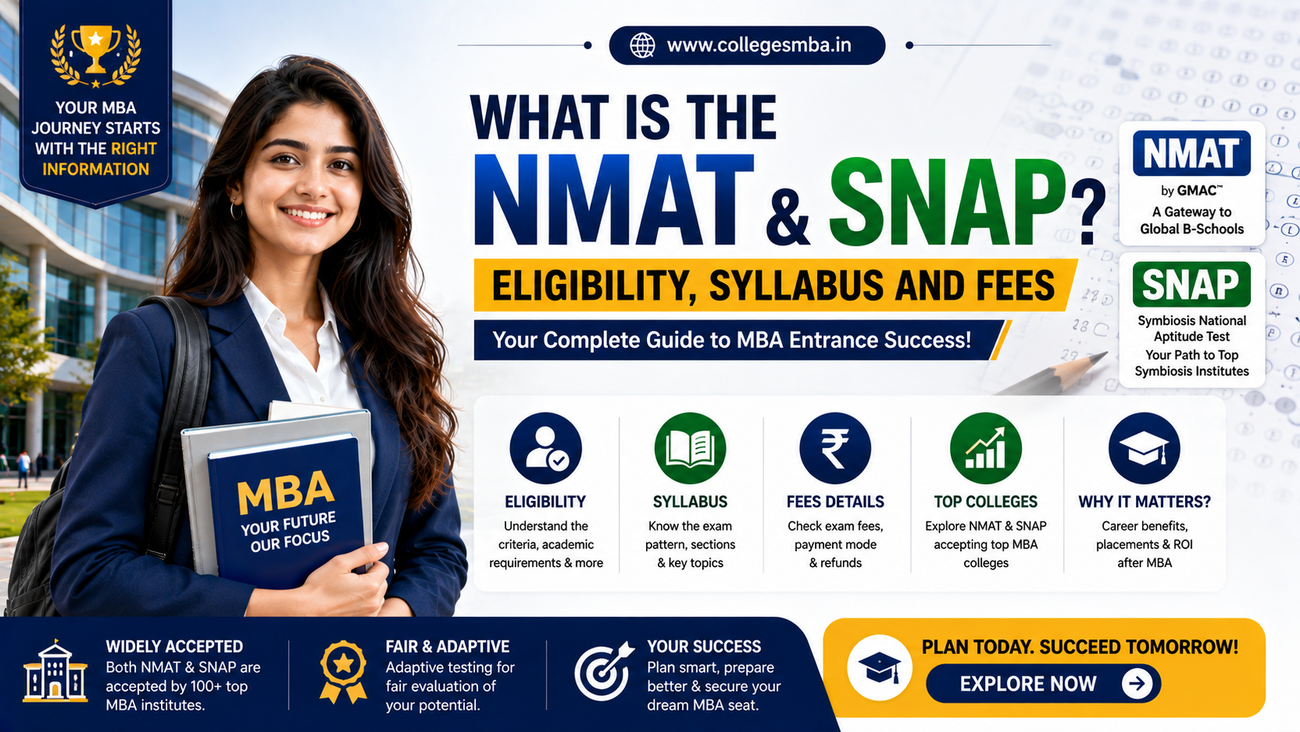
What Is the NMAT & SNAP? Eligibility, Syllabus and Fees
Hey there, future management leader! If you are setting your sights on prestigious B-schools like NMIMS Mumbai or Symbiosis institutes (SIBM Pune, SCMHRD), you are likely looking at two very important exams: NMAT and SNAP.
Both are highly popular, national-level entrance exams, but they cater to different universities. What makes them unique? NMAT offers a 75-day testing window with no negative marking, while SNAP is a high-speed, 60-minute sprint that allows multiple attempts! As you gear up for the 2027 admission cycle, having a clear roadmap is absolutely crucial. In this comprehensive, EEAT-compliant guide, we will answer the ultimate question: What Is the NMAT & SNAP? Eligibility, Syllabus and Fees, Registration, Result Date, Last Date, application Fees, Course Fees 2027. Let’s dive in!
What is the NMAT Exam?
The NMAT (NMIMS Management Aptitude Test) is a computer-based, national-level entrance examination conducted by the Graduate Management Admission Council (GMAC). It serves as the primary gateway for admission into various postgraduate management programs (MBA/PGDM) across NMIMS campuses and 50+ other premier B-schools in India and abroad.
NMAT Exam Pattern:
| Section | Number of Questions | Time Allotted | Marking Scheme |
|---|---|---|---|
| Language Skills | 36 | 28 Minutes | +1 for correct, No negative marking |
| Quantitative Skills | 36 | 52 Minutes | +1 for correct, No negative marking |
| Logical Reasoning | 36 | 40 Minutes | +1 for correct, No negative marking |
| Total | 108 Questions | 120 Minutes | Total Marks: 360 |
What is the SNAP Exam?
The SNAP (Symbiosis National Aptitude Test) is a computer-based, national-level entrance examination conducted by Symbiosis International (Deemed University). It serves as the mandatory gateway for admission into various postgraduate management programs (MBA/PGDM) across the 15 prestigious Symbiosis institutes in India.
SNAP Exam Pattern:
| Section | Number of Questions | Time Allotted | Marking Scheme |
|---|---|---|---|
| General English | 15 | 60 Minutes (Combined) | +1 for correct, -0.25 for wrong |
| Analytical & Logical Reasoning | 25 | 60 Minutes (Combined) | +1 for correct, -0.25 for wrong |
| Quantitative, DI & Data Sufficiency | 20 | 60 Minutes (Combined) | +1 for correct, -0.25 for wrong |
| Total | 60 Questions | 60 Minutes | Total Marks: 60 |
NMAT & SNAP 2027 Eligibility Criteria
The eligibility criteria for both NMAT and SNAP are quite similar and inclusive.
- Educational Qualification: You must hold a recognized Bachelor’s degree in any discipline (B.A., B.Sc., B.Com, B.Tech, etc.) from a recognized university or institution.
- Minimum Marks Required: General, EWS, and NC-OBC candidates must have a minimum of 50% aggregate marks (or equivalent CGPA) in their bachelor’s degree. For SC, ST, and PwD candidates, the minimum requirement is relaxed to 45%.
- Final-Year Students: If you are in your final year of your bachelor’s degree (graduating in 2027), you are fully eligible to apply. You will be admitted provisionally and must submit your final passing certificate before the MBA program commences.
- Age Limit: There is no age limit to appear for either the NMAT or SNAP exam.
- Work Experience: Work experience is not mandatory to apply for either exam. Freshers can apply. However, having work experience (usually 1 to 3 years) is given extra weightage by NMIMS Mumbai and SCMHRD during the final selection process.
NMAT & SNAP 2027 Syllabus
Neither GMAC nor SIU officially releases a prescribed syllabus. However, based on years of rigorous paper analysis, here is the breakdown:
1. NMAT 2027 Syllabus
- Language Skills: Reading Comprehension, Vocabulary (Synonyms, Antonyms, Analogies), Grammar, and Para-jumbles.
- Quantitative Skills: Arithmetic (Percentages, Profit & Loss, Time & Work), Algebra, Geometry, Number Systems, and Data Interpretation (Tables, Graphs).
- Logical Reasoning: Analytical Reasoning (Blood relations, seating arrangements, puzzles, coding-decoding) and Critical Reasoning (Arguments, assumptions, conclusions).
2. SNAP 2027 Syllabus
- General English: Reading Comprehension (short passages), Vocabulary, Grammar, Sentence Correction, and Active/Passive voice.
- Analytical & Logical Reasoning: Blood relations, seating arrangements, puzzles, syllogisms, coding-decoding, series, clocks & calendars, and critical reasoning.
- Quantitative, DI & Data Sufficiency: Arithmetic, Algebra, Geometry, Number Systems, Modern Math, Data Interpretation (Tables, Pie charts), and Data Sufficiency questions.
NMAT & SNAP 2027 Important Dates (Expected Timeline)
Here is the expected timeline for the 2027 admission cycle (exams conducted in late 2026):
| Event | NMAT 2026/2027 | SNAP 2026/2027 |
|---|---|---|
| Registration Start Date | First week of August 2026 | First week of August 2026 |
| Registration Last Date | Second week of October 2026 | Third week of November 2026 |
| Admit Card Release | Available upon scheduling | First week of December 2026 |
| Exam Window | October to December 2026 | Three Sundays in December 2026 |
| Result Declaration | Within 48 hours (Final scorecard in Jan 2027) | First week of January 2027 |
NMAT & SNAP 2027 Application Fees & Course Fees
Application Fees
- NMAT 2027 Application Fee: Approximately ₹2,800 (inclusive of taxes). Retakes cost an additional ₹2,800 per attempt. Rescheduling costs ₹1,100 + taxes.
- SNAP 2027 Application Fee: Approximately ₹2,250 (inclusive of taxes) for the first attempt. Each retake costs approximately ₹1,250.
- Important SNAP Note: In addition to the SNAP test fee, you must pay an Institute Preference Fee of ₹1,000 per Symbiosis institute you wish to apply to (e.g., SIBM Pune, SCMHRD).
Course Fees (at Top Colleges for 2027)
The course fees for the MBA program vary by campus:
- NMIMS Mumbai (via NMAT): Approximately ₹21-23 Lakhs for the 2-year full-time MBA.
- SIBM Pune (via SNAP): Approximately ₹24-25 Lakhs for the 2-year full-time MBA.
- SCMHRD Pune (via SNAP): Approximately ₹23-24 Lakhs.
- NMIMS Bangalore (via NMAT): Approximately ₹19-20 Lakhs.
- SIIB Pune (via SNAP): Approximately ₹20-21 Lakhs.
How to Register for NMAT & SNAP 2027?
For NMAT:
- Visit the official website:
mba.com/nmat. - Create a new user account, fill in your details, and select your preferred 5 B-schools.
- Pay the application fee of ₹2,800 and schedule your exam date, time, and center.
- Download the confirmation receipt.
For SNAP:
- Visit the official website:
snaptest.org. - Register, fill in your personal and academic details, and upload your photo and signature.
- Pay the SNAP application fee of ₹2,250.
- Crucial: Pay the institute preference fee (₹1,000 per institute) for the specific Symbiosis colleges you want to apply to.
Conclusion
Both the NMAT and SNAP exams are fantastic opportunities for MBA aspirants. NMAT is perfect if you prefer a longer exam with no negative marking and want to target NMIMS, while SNAP is ideal if you thrive under speed-based conditions and dream of Symbiosis. Now that you have the complete breakdown of What Is the NMAT & SNAP? Eligibility, Syllabus and Fees, Registration, Result Date, Last Date, application Fees, Course Fees 2027, you can create a solid study plan. Start early, clear your basics, take regular mock tests, and focus on speed. Best of luck on your journey to becoming a future management leader!
Frequently Asked Questions (FAQs)
The NMAT 2027 application fee is approximately ₹2,800. The SNAP 2027 application fee is approximately ₹2,250 for the first attempt. For SNAP, you must also pay an additional ₹1,000 per Symbiosis institute you apply to.
Yes, final-year graduation students are eligible to apply for both exams provisionally. They must submit their final passing certificate before the MBA program commences.
There is no negative marking in NMAT. However, SNAP has a strict negative marking of -0.25 marks for every incorrect answer.
The NMAT 2026 registration last date is expected to be in the second week of October 2026. The SNAP 2026 registration last date is expected to be in the third week of November 2026.
The course fee for the 2-year full-time MBA program at NMIMS Mumbai is approximately ₹21-23 Lakhs. At SIBM Pune, the course fee is approximately ₹24-25 Lakhs.
What Is the GMAT Exam? Eligibility, Syllabus and Fees, Registration, Result Date, Last Date, Application Fees, Course Fees 2027
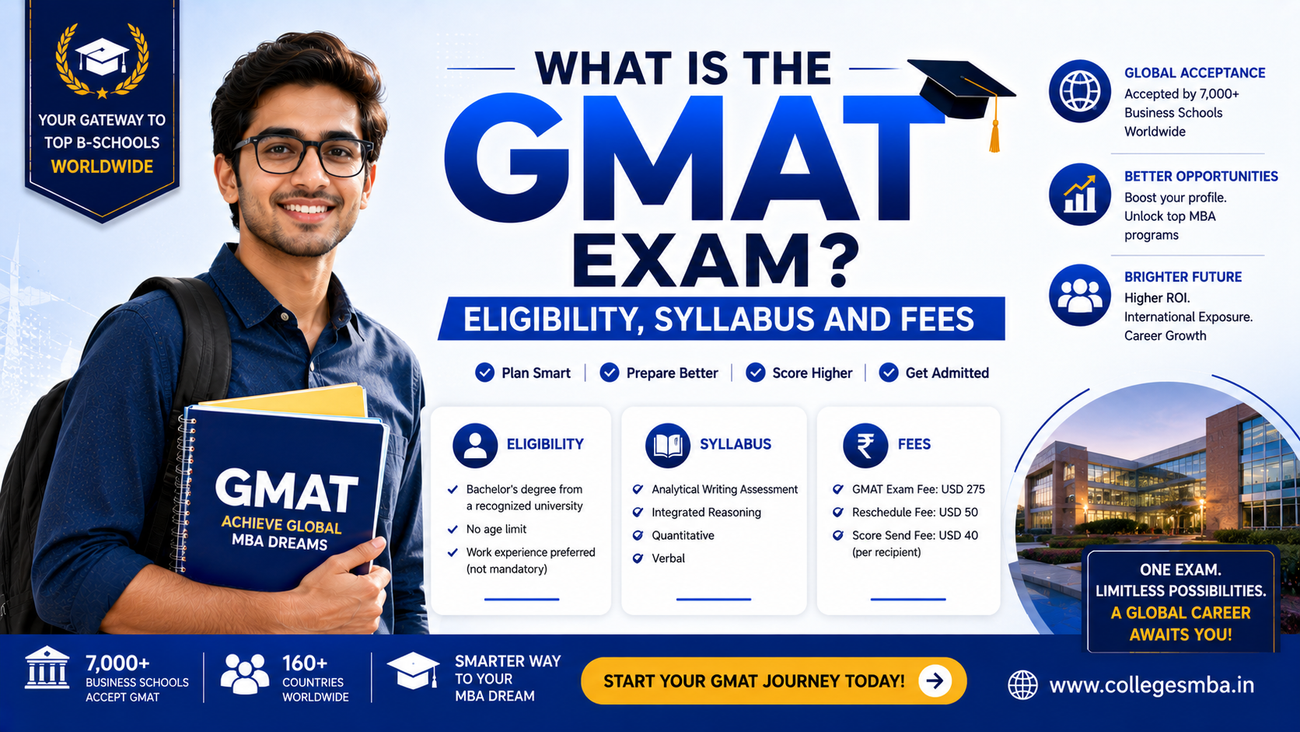
What Is the GMAT Exam Eligibility, Syllabus and Fees 2027
Hey there, future global management leader! If you are dreaming of walking the prestigious corridors of top international business schools like Stanford, Harvard, Wharton, or the Indian School of Business (ISB), cracking the GMAT is your golden ticket.
The Graduate Management Admission Test (GMAT) is a globally recognized, computer-adaptive entrance exam conducted by the Graduate Management Admission Council (GMAC). As you gear up for the 2027 admission cycle, having a clear roadmap is absolutely crucial. In this comprehensive, EEAT-compliant guide, we will answer the ultimate question: What Is the GMAT Exam? Eligibility, Syllabus and Fees, Registration, Result Date, Last Date, application Fees, Course Fees 2027. Let’s dive in!
What is the GMAT Exam?
The GMAT is a standardized, computer-adaptive test (CAT) designed specifically to evaluate the analytical, quantitative, and verbal skills of candidates aspiring to pursue MBA and business master’s programs worldwide. It is accepted by over 7,000 programs at approximately 2,300 graduate business schools globally.
Recently, GMAC introduced the GMAT Focus Edition, a shorter, more streamlined version of the classic exam. The new version is highly relevant to modern business needs, focusing heavily on data literacy and critical reasoning, and completely removes the classic AWA (Analytical Writing Assessment) section.
GMAT 2027 Exam Pattern (Focus Edition)
Before we jump into the syllabus and fees, it is crucial to understand the structure of the exam. The new GMAT Focus Edition consists of three sections. Here is a detailed table breaking down the GMAT 2027 exam pattern:
| Section | Number of Questions | Time Allotted | Score Range |
|---|---|---|---|
| Quantitative Reasoning | 21 | 45 Minutes | 60 – 90 |
| Verbal Reasoning | 23 | 45 Minutes | 60 – 90 |
| Data Insights | 20 | 45 Minutes | 60 – 90 |
| Total | 64 Questions | 135 Minutes (2 Hrs 15 Mins) | 205 – 805 |
Crucial Note: The exam is entirely computer-adaptive, meaning the difficulty of the next question depends on your answer to the current one. You can now review your answers and bookmark questions to return to later within a section.
GMAT 2027 Eligibility Criteria
The eligibility criteria for the GMAT are quite flexible, making it accessible to a wide range of candidates.
- Educational Qualification: GMAC does not have any strict educational prerequisites to take the test. However, since the GMAT is for MBA admissions, you must hold a recognized Bachelor’s degree in any discipline to be eligible for admission to business schools.
- Minimum Marks: There is no minimum percentage required by GMAC to take the test. Individual B-schools, however, will evaluate your past academic record during the admission process.
- Age Limit: You must be at least 18 years old to take the GMAT without restrictions. If you are between 13 and 17 years old, you can still apply, but you will need a permission letter signed by your parents or legal guardians.
- Work Experience: Work experience is not mandatory to take the GMAT. Freshers can apply. However, top global B-schools generally prefer candidates with 2 to 5 years of professional work experience for their flagship MBA programs.
- Number of Attempts: You can take the GMAT once every 16 calendar days, with a maximum of 5 attempts in a rolling 12-month period. The lifetime limit is 8 attempts.
GMAT 2027 Syllabus
GMAC does not release a rigid, itemized syllabus. However, based on the official GMAT Official Guide and years of rigorous paper analysis, the syllabus is broadly divided into three sections. Let’s break them down:
1. Quantitative Reasoning
This section tests your foundational mathematical skills and your ability to reason quantitatively. It is purely problem-solving; the classic Data Sufficiency questions have now been moved to the Data Insights section.
- Arithmetic: Percentages, ratios, fractions, number properties, integers, and probability.
- Algebra: Linear and quadratic equations, inequalities, functions, and exponents.
- Geometry: Lines, angles, triangles, circles, and coordinate geometry.
- Word Problems: Practical, real-world business math scenarios.
2. Verbal Reasoning
This section tests your ability to read, comprehend, and evaluate written material, as well as your grasp of standard written English.
- Reading Comprehension (RC): Passages from diverse topics like science, history, economics, and business. Questions test main ideas, inferences, and application.
- Critical Reasoning (CR): Short arguments followed by questions that test your ability to evaluate arguments, identify assumptions, and strengthen/weaken conclusions.
3. Data Insights
This is the newest and most innovative section, testing your ability to analyze and interpret data in various formats.
- Data Sufficiency: Determining whether the data provided in two statements is sufficient to answer a quantitative question.
- Multi-Source Reasoning: Analyzing data from multiple tabs (tables, text, graphs) to answer questions.
- Table Analysis: Sorting and analyzing a data table to answer true/false statements.
- Graphics Interpretation: Interpreting data from scatter plots, bar charts, and pie charts.
- Two-Part Analysis: Solving complex problems with two interdependent components (could be quant or verbal).
GMAT 2027 Important Dates (Expected Timeline)
Unlike Indian entrance exams, the GMAT does not have a single “exam day.” It is conducted year-round. However, for the 2027 admission cycle, here is the expected timeline:
| Event | Expected Timeline (2026-2027) |
|---|---|
| GMAT Registration Open | Ongoing (Year-round) |
| GMAT 2027 Registration Last Date | You can register up to 24 hours before your desired test date (subject to slot availability). |
| Exam Window | Anytime between Oct 2026 and Jan 2027 (for 2027 intakes) |
| Result Date (Unofficial) | Immediately after completing the exam. |
| Result Date (Official Scorecard) | Within 3-7 days of taking the exam. |
| Score Validity | 5 Years from the date of the exam. |
Note on Last Date: The “last date” to apply for the GMAT is entirely dependent on your target B-school’s application deadlines (Round 1 usually closes in September/October 2026, Round 2 in January 2027). You must take the GMAT at least 2-3 weeks before the B-school deadline to ensure your official scores are sent in time.
GMAT 2027 Application Fees & Course Fees
Application Fees
Taking the GMAT is a significant financial investment. Here is the complete breakdown of the GMAT 2027 application fees:
- GMAT Registration Fee: $275 USD (Approximately ₹23,000 INR, inclusive of taxes).
- Rescheduling Fee: If you reschedule your exam more than 24 hours before your appointment, you will be charged a fee of $55 USD (Approximately ₹4,600 INR).
- Cancellation Fee: If you cancel your exam 1 to 14 days before the test date, you will receive a refund of $55 USD. No refund is provided if you cancel within 24 hours.
- Additional Score Reports: You can send your scores to 5 B-schools for free. Sending scores to each additional college costs $35 USD (Approximately ₹2,900 INR).
Course Fees (at Top Global B-Schools for 2027)
The course fees for an MBA program at top global colleges accepting GMAT vary drastically by region and institution. Here are the estimated fees for the 2027 batch:
- Indian School of Business (ISB), India: Approximately ₹50-55 Lakhs for the 1-year PGP.
- Harvard Business School (HBS), USA: Approximately $84,000 USD/year (~₹70 Lakhs INR).
- Stanford GSB, USA: Approximately $82,000 USD/year (~₹68 Lakhs INR).
- INSEAD, France/Singapore: Approximately €89,000 EUR (~₹80 Lakhs INR) for the 10-month program.
- London Business School (LBS), UK: Approximately £85,000 GBP (~₹90 Lakhs INR) for the 15-21 month program.
How to Register for GMAT 2027?
The registration process is entirely online and can be done year-round. Follow these steps:
- Visit the official website:
mba.com. - Create a new user account using your valid email ID.
- Log in and verify your profile details.
- Select the “Register for the GMAT” option.
- Choose your preferred exam mode (Test Center or Online/Remote).
- Select your preferred test date and time slot.
- Pay the application fee of $275 USD online via credit/debit card.
- Download and save the confirmation receipt.
Top Business Schools Accepting GMAT Scores
Cracking the GMAT opens doors to the most prestigious B-schools in the world. Some of the top institutes include:
- Stanford Graduate School of Business (USA)
- Harvard Business School (USA)
- Wharton School of the University of Pennsylvania (USA)
- INSEAD (France/Singapore)
- London Business School (UK)
- Indian School of Business (ISB), India
- IIMs (for Executive MBA programs)
Conclusion
The GMAT exam is your gateway to a global business career. Now that you have the complete breakdown of What Is the GMAT Exam? Eligibility, Syllabus and Fees, Registration, Result Date, Last Date, application Fees, Course Fees 2027, you can create a solid study plan. The new Focus Edition is shorter and more focused on data skills, making it highly relevant for modern business leaders. Start early, clear your basics, take official mock tests, and focus on time management. With consistent effort, you can easily secure a 700+ equivalent score and gain admission to your dream B-school. Best of luck!
Frequently Asked Questions (FAQs)
The GMAT 2027 registration fee is $275 USD, which approximately translates to ₹23,000 INR (inclusive of taxes).
You will receive your unofficial score immediately after completing the exam. The official scorecard is usually declared and made available in your mba.com account within 3 to 7 days of taking the test.
No, work experience is not mandatory to take the GMAT exam. Freshers can apply. However, top global B-schools generally prefer candidates with 2 to 5 years of professional work experience for their flagship MBA programs.
The GMAT Focus Edition has a new total score range of 205 to 805. Each of the three sections (Quantitative, Verbal, Data Insights) has a score range of 60 to 90.
The GMAT is conducted year-round, so there is no specific “last date.” You can register up to 24 hours before a test date, subject to slot availability. However, your actual last date depends on the Round 1 or Round 2 deadline of the B-school you are applying to.
What Is the XAT Exam? Eligibility, Syllabus and Fees, Registration, Result Date, Last Date, Application Fees, Course Fees 2027
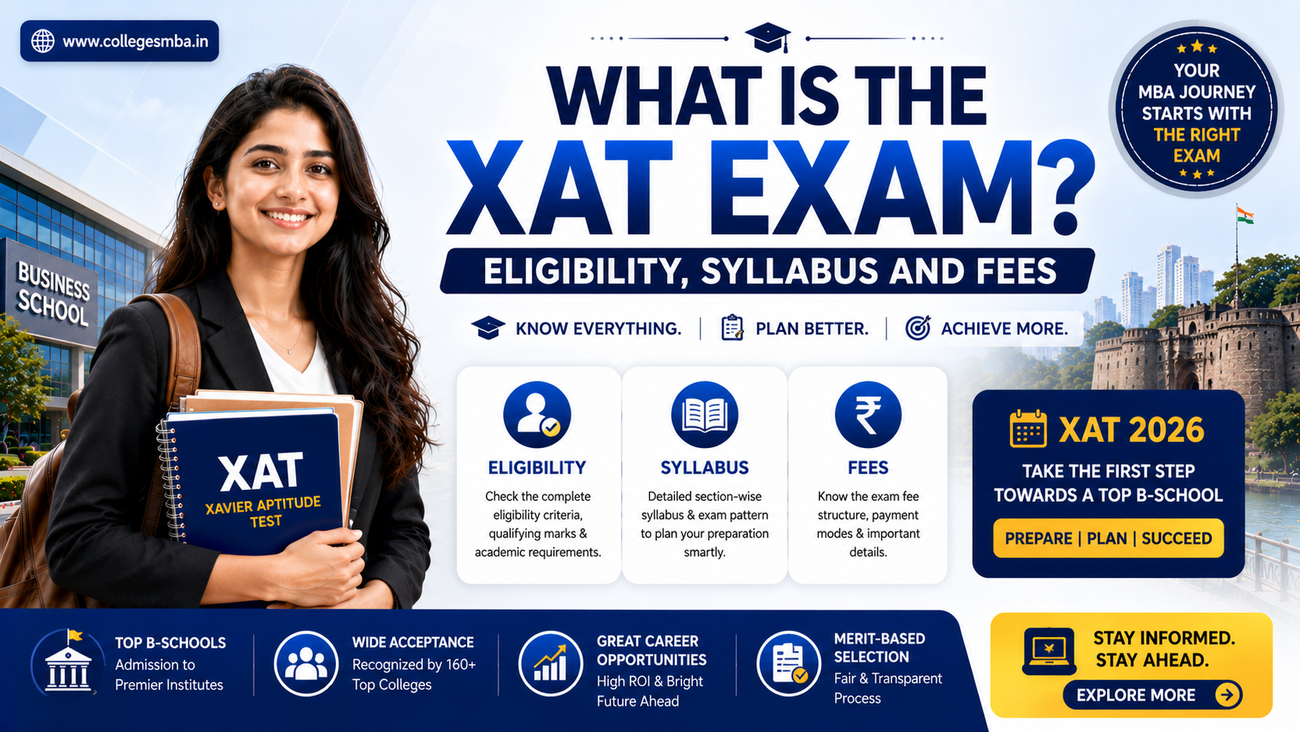
What Is the XAT Exam? Eligibility, Syllabus and Fees 2027
Hey there, future management leader! If you are setting your sights on prestigious B-schools like XLRI Jamshedpur, SPJIMR Mumbai, or IMT Ghaziabad, cracking the XAT is your golden ticket.
The Xavier Aptitude Test (XAT) is one of India’s most prestigious and rigorous national-level MBA entrance exams. What makes it unique is its focus on “Decision Making”—a section that tests your real-world managerial and ethical judgment! As you gear up for the 2027 admission cycle, having a clear roadmap is absolutely crucial. In this comprehensive, EEAT-compliant guide, we will answer the ultimate question: What Is the XAT Exam? Eligibility, Syllabus and Fees, Registration, Result Date, Last Date, application Fees, Course Fees 2027. Let’s dive in!
What is the XAT Exam?
The XAT (Xavier Aptitude Test) is a computer-based, national-level entrance examination conducted by XLRI (Xavier School of Management) on behalf of the Xavier Association of Management Institutes (XAMI). It serves as the primary gateway for admission into various postgraduate management programs (MBA/PGDM) across XLRI and 160+ other premier B-schools in India.
The exam is designed to evaluate a candidate’s quantitative aptitude, verbal ability, logical reasoning, and decision-making skills. It is highly respected by top corporate recruiters because the exam rigorously tests a candidate’s ability to handle complex, real-world business dilemmas.
XAT 2027 Exam Pattern
Before we jump into the syllabus and fees, it is crucial to understand the structure of the exam. Here is a detailed table breaking down the XAT 2027 exam pattern:
| Part | Section | Number of Questions | Time Allotted | Marking Scheme |
|---|---|---|---|---|
| Part 1 | Verbal & Logical Ability (VALR) | 26 | 170 Minutes (Combined) | +1 for correct, -0.25 for wrong |
| Decision Making (DM) | 22 | 170 Minutes (Combined) | +1 for correct, -0.25 for wrong | |
| Quantitative Aptitude & Data Interpretation (QADI) | 28 | 170 Minutes (Combined) | +1 for correct, -0.25 for wrong | |
| Part 2 | Mock Keyboard Testing | 1 | 5 Minutes | No Marks |
| Part 3 | General Knowledge (GK) | 25 | 10 Minutes | +1 for correct, No negative marking |
| Part 4 | Essay Writing | 1 | 10 Minutes | Evaluated for shortlisted candidates |
| Total | 75 (MCQs) + 1 Essay | 195 Minutes | Total Marks: 75 (for Percentile) |
Crucial Note: There is a unique penalty in XAT: a deduction of -0.10 marks for more than 8 consecutive unattempted questions. However, there is no negative marking in the GK section, and the Essay is only evaluated if you are shortlisted for the PI round.
XAT 2027 Eligibility Criteria
Before you pay the application fee, you must ensure you meet the XAT 2027 eligibility criteria. The rules are inclusive but strict regarding academic qualifications.
- Educational Qualification: You must hold a recognized Bachelor’s degree in any discipline (B.A., B.Sc., B.Com, B.Tech, etc.) from a recognized university or institution.
- Minimum Marks Required: Unlike CAT, XAT does not strictly mandate a minimum 50% mark in graduation. A passing degree is sufficient. However, a decent academic record is preferred by XLRI during the final selection.
- Final-Year Students: If you are in your final year of your bachelor’s degree (graduating in 2027), you are fully eligible to apply. You will be admitted provisionally and must submit your final passing certificate before the MBA program commences.
- Age Limit: There is no age limit to appear for the XAT exam.
- Work Experience: Work experience is not mandatory to apply. Freshers can apply. However, having work experience (usually 1 to 3 years) is given extra weightage by XLRI and other top B-schools during the final selection process.
XAT 2027 Syllabus
XLRI does not officially release a prescribed XAT syllabus. However, based on years of rigorous paper analysis, the syllabus is broadly divided into four sections plus an essay. Let’s break them down:
1. Verbal & Logical Ability
This section tests your grasp of the English language, your reading speed, and your critical reasoning.
- Reading Comprehension (RC): Passages from philosophy, literature, economics, sociology, and science.
- Verbal Ability: Vocabulary, fill-in-the-blanks, para-jumbles, and grammar.
- Logical Reasoning: Blood relations, seating arrangements, puzzles, syllogisms, and coding-decoding.
2. Decision Making (DM)
This is the most unique section of XAT. There is no fixed syllabus.
- Topics: Ethical dilemmas, business scenarios, HR issues, and managerial decisions. You will be given short case studies where you must choose the most logical and ethical course of action.
3. Quantitative Aptitude & Data Interpretation
This section is often considered the toughest.
- Quantitative Aptitude: Arithmetic, Algebra, Geometry, Number Systems, Probability, and P&C.
- Data Interpretation (DI): Tables, bar graphs, pie charts, and line charts. Calculations can be intensive.
4. General Knowledge
- Current Affairs: Last 12-18 months of news (economy, business, sports, politics).
- Static GK: History, geography, polity, science, and literature.
5. Essay Writing
- Candidates must write a short essay (approx. 250-300 words) on an abstract or current topic (e.g., “Ethics in Business” or “Technology and Human Interaction”).
XAT 2027 Important Dates (Expected)
Here is the expected timeline for the XAT 2027 admission cycle:
| Event | Expected Timeline (2026) |
|---|---|
| XAT 2027 Registration Start Date | First week of August 2026 |
| XAT 2027 Registration Last Date | First week of December 2026 |
| Admit Card Release | Third week of December 2026 |
| Exam Date | First Sunday of January 2027 |
| Result Declaration | Third week of January 2027 |
XAT 2027 Application Fees & Course Fees
Application Fees
To complete your registration, you must pay the XAT application fee online. The fee structure is as follows:
- XAT 2027 Application Fee: Approximately ₹2,100 (inclusive of taxes).
- Late Fee: XAT does not typically have a late fee window. The portal closes strictly on the announced last date.
- XLRI Program Fee: If you wish to apply to XLRI programs specifically, you must pay an additional fee of approximately ₹300.
Course Fees (at Top Colleges)
The course fees for the MBA program at top colleges accepting XAT vary by institute:
- XLRI Jamshedpur: Approximately ₹23-25 Lakhs for the 2-year full-time PGDM.
- SPJIMR Mumbai: Approximately ₹20-22 Lakhs.
- IMT Ghaziabad: Approximately ₹21-23 Lakhs.
- XIMB Bhubaneswar: Approximately ₹19-21 Lakhs.
How to Register for XAT 2027?
The registration process is entirely online. Follow these steps to fill out the XAT 2027 application form:
- Visit the official website:
xatonline.in. - Create a new user account using your valid email ID and mobile number.
- Log in with your User ID and Password.
- Fill in your personal, academic, and work experience details.
- Select your preferred XLRI campus (Jamshedpur or Delhi) and other associate institutes.
- Upload your passport-size photograph and signature.
- Pay the XAT application fee online.
- Download and save the confirmation page for future reference.
Top Colleges Accepting XAT Scores
Cracking XAT opens doors to over 160 premier B-schools in India. Some of the top institutes include:
- XLRI (Xavier School of Management), Jamshedpur & Delhi
- S.P. Jain Institute of Management and Research (SPJIMR), Mumbai
- Institute of Management Technology (IMT), Ghaziabad
- Xavier Institute of Management (XIMB), Bhubaneswar
- T.A. Pai Management Institute (TAPMI), Manipal
- FORE School of Management, New Delhi
Conclusion
The XAT exam is a fantastic opportunity for MBA aspirants to showcase their decision-making and logical reasoning skills. Now that you have the complete breakdown of What Is the XAT Exam? Eligibility, Syllabus and Fees, Registration, Result Date, Last Date, application Fees, Course Fees 2027, you can create a solid study plan. Start early, clear your basics, practice DM case studies, and take regular mock tests. With consistent effort, you can easily secure a 90+ percentile and gain admission to your dream B-school. Best of luck!
Frequently Asked Questions (FAQs)
The XAT 2027 application fee is approximately ₹2,100. If you wish to apply to XLRI programs specifically, you must pay an additional fee of approximately ₹300.
Yes, final-year graduation students are eligible to apply for XAT 2027 provisionally. They must submit their final passing certificate before the MBA program commences.
Yes, there is a negative marking of -0.25 marks for every incorrect answer. Additionally, there is a penalty of -0.10 marks for more than 8 consecutive unattempted questions. However, the General Knowledge section has no negative marking.
The XAT 2027 registration last date is expected to be in the first week of December 2026. The exam is conducted on the first Sunday of January 2027.
The course fee for the 2-year full-time PGDM program at XLRI Jamshedpur is approximately ₹23-25 Lakhs.