
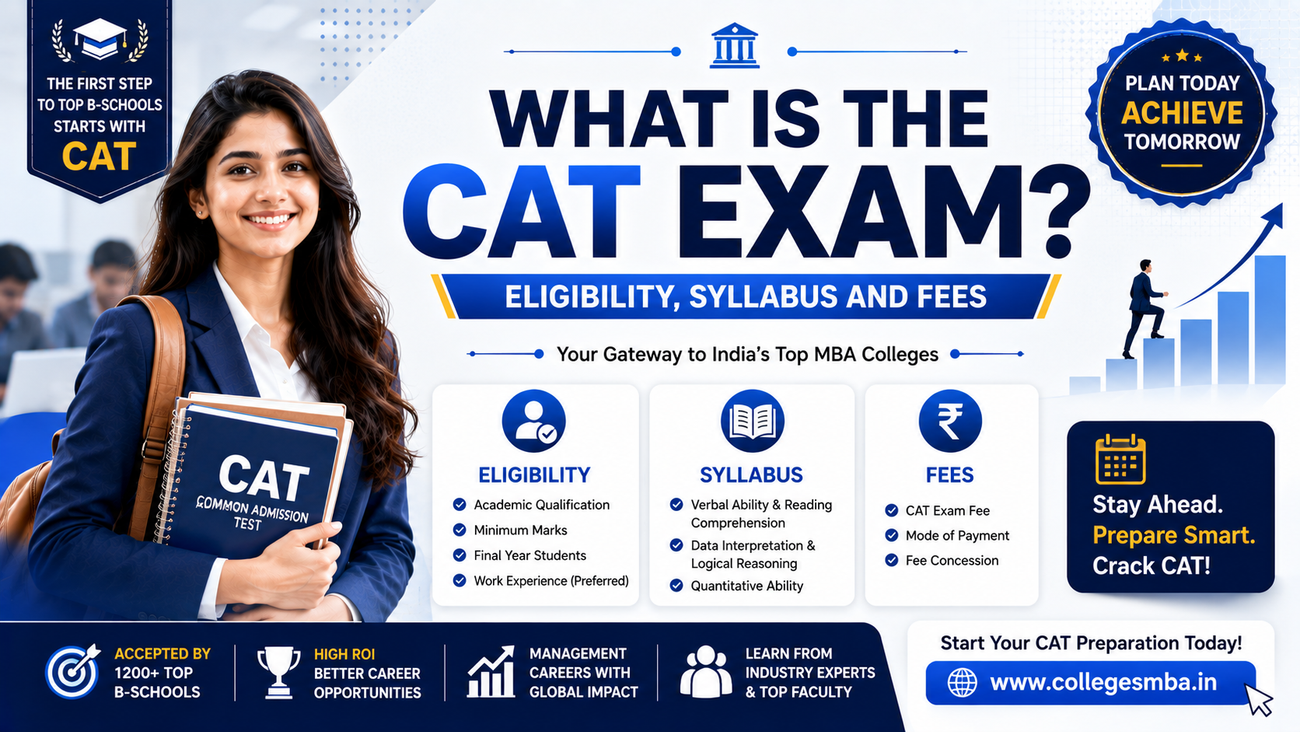
What Is the CAT Exam? Eligibility, Syllabus and Fees
Hey there, future management leader! If you are dreaming of walking the prestigious corridors of the Indian Institutes of Management (IIMs) or top-tier B-schools like FMS, MDI, or SPJIMR, cracking the CAT is your golden ticket.
The Common Admission Test (CAT) is India’s most prestigious and competitive MBA entrance exam. As you gear up for the 2026 admission cycle, having a clear roadmap is absolutely crucial. In this comprehensive, EEAT-compliant guide, we will answer the ultimate question: What is the CAT Exam? Eligibility, Syllabus and Fees 2026. Let’s dive in and get your prep journey started!
What is the CAT Exam?
The CAT (Common Admission Test) is a national-level computer-based entrance examination conducted by the IIMs on a rotational basis. It serves as the primary gateway for admission into various postgraduate management programs (MBA/PGDM) across 21 IIMs and over 1,200 premier B-schools in India.
The exam is designed to evaluate a candidate’s quantitative aptitude, data interpretation, logical reasoning, and verbal ability. It is a highly competitive, time-bound test that not only checks your academic knowledge but also your ability to manage time and make quick decisions under pressure.
CAT 2026 Exam Pattern
Before we jump into the syllabus and fees, it is crucial to understand the structure of the exam. The CAT exam pattern has remained largely consistent over the last few years. Here is a detailed table breaking down the CAT 2026 exam pattern:
| Section | Number of Questions | Time Allotted | Marking Scheme |
|---|---|---|---|
| Verbal Ability & Reading Comprehension (VARC) | 24 | 40 Minutes | +3 for correct, -1 for wrong MCQ |
| Data Interpretation & Logical Reasoning (DILR) | 20 | 40 Minutes | +3 for correct, -1 for wrong MCQ |
| Quantitative Aptitude (QA) | 22 | 40 Minutes | +3 for correct, -1 for wrong MCQ |
| Total | 66 Questions | 120 Minutes (2 Hours) | Total Marks: 198 |
Crucial Note: You cannot switch between sections. The 40-minute time limit is strictly enforced per section. However, there is no negative marking for TITA (Type In The Answer) questions.
CAT 2026 Eligibility Criteria
Before you pay the application fee, you must ensure you meet the CAT 2026 eligibility criteria. The rules are inclusive but strict regarding academic qualifications.
- Educational Qualification: You must hold a recognized Bachelor’s degree in any discipline (B.A., B.Sc., B.Com, B.Tech, etc.).
- Minimum Marks Required: General, EWS, and NC-OBC candidates must have a minimum of 50% aggregate marks (or equivalent CGPA) in their bachelor’s degree. For SC, ST, and PwD candidates, the minimum requirement is relaxed to 45%.
- Final-Year Students: If you are in your final year of your bachelor’s degree (graduating in 2027), you are fully eligible to apply. You will be admitted provisionally and must submit your final passing certificate before the MBA program commences.
- Age Limit: There is no age limit to appear for the CAT exam.
- Work Experience: Work experience is not mandatory to apply. Freshers can apply. However, having work experience (usually 1 to 3 years) is given extra weightage by top IIMs during the final selection process.
CAT 2026 Syllabus
The IIMs do not officially release a prescribed CAT syllabus. However, based on years of rigorous paper analysis, the syllabus is broadly divided into three sections. Let’s break them down:
1. Verbal Ability and Reading Comprehension (VARC)
This section tests your grasp of the English language, your reading speed, and your ability to understand complex texts.
- Reading Comprehension (RC): Passages from diverse topics like philosophy, history, science, economics, and sociology (makes up 70% of this section).
- Verbal Ability (VA): Para-jumbles, para-summary, odd-one-out, and sentence completion.
2. Data Interpretation and Logical Reasoning (DILR)
This is often considered the trickiest and most unpredictable section. It tests your ability to decode data and solve logical puzzles.
- Data Interpretation (DI): Tables, bar graphs, pie charts, line charts, and logical DI sets.
- Logical Reasoning (LR): Seating arrangements, blood relations, puzzles, Venn diagrams, syllogisms, and games & tournaments.
3. Quantitative Aptitude (QA)
This section is heavily focus.ed on core mathematics and requires deep conceptual clarity.
- Arithmetic: Percentages, Profit & Loss, Time & Work, Time-Speed-Distance, Averages, and Ratios (Highest weightage).
- Algebra: Linear and quadratic equations, inequalities, logarithms, and functions.
- Geometry & Mensuration: Triangles, circles, coordinate geometry, and polygons.
- Modern Math: Permutations & combinations, probability, and set theory.
CAT 2026 Application Fees
To complete your registration, you must pay the CAT application fee online. The fee structure is as follows:
- General, EWS, and NC-OBC Candidates: ₹2,400 (approx.)
- SC, ST, and PwD Candidates: ₹1,200 (approx.)
Pro Tip: You can pay the fee using Credit Cards, Debit Cards, UPI, or Net Banking. Keep your transaction receipts safe, as you may need them for reimbursement or verification purposes.
How to Apply for CAT 2026?
The registration process is entirely online. Follow these steps to fill out the CAT 2026 application form:
- Visit the official website:
iimcat.ac.in. - Create a new user account using your valid email ID and mobile number.
- Log in with your User ID and Password.
- Fill in your personal, academic, and work experience details.
- Select your preferred IIMs and 6 test city preferences.
- Upload your passport-size photograph and signature as per the specified dimensions.
- Pay the application fee online and submit the form.
- Download and save the confirmation page for future reference.
Top Colleges Accepting CAT Scores
Cracking CAT opens doors to the most prestigious B-schools in India. Some of the top institutes include:
- The 21 IIMs (IIM Ahmedabad, Bangalore, Calcutta, Lucknow, etc.)
- Faculty of Management Studies (FMS), Delhi University
- Management Development Institute (MDI), Gurgaon
- S.P. Jain Institute of Management and Research (SPJIMR), Mumbai
- Indian Institutes of Technology (IITs) (IIT Bombay, IIT Delhi, IIT Kharagpur)
- National Institute of Industrial Engineering (NITIE), Mumbai
Conclusion
The CAT exam is a marathon, not a sprint. Now that you have the complete breakdown of What is the CAT Exam? Eligibility, Syllabus and Fees 2026, you can create a solid study plan. Start early, clear your basics, take regular mock tests, and analyze your mistakes. With consistent effort, you can easily secure a 95+ percentile and secure your spot in your dream B-school. Best of luck!
Frequently Asked Questions (FAQs)
The CAT 2026 application fee is approximately ₹2,400 for General/EWS/NC-OBC candidates and ₹1,200 for SC/ST/PwD candidates.
Yes, final-year graduation students are eligible to apply for CAT 2026 provisionally. They must submit their final passing certificate before the MBA program commences.
Yes, there is a negative marking of -1 for every incorrect Multiple Choice Question (MCQ). However, there is no negative marking for Type-In-The-Answer (TITA) questions. For every correct answer, you are award.ed +3 marks.
General, EWS, and NC-OBC candidates need a minimum of 50% aggregate marks in their bachelor’s degree. For SC, ST, and PwD candidates, the minimum requirement is relax.ed to 45%.
No, the IIMs do not officially release a syllabus, and the core topics (VARC, DILR, QA) remain largely consistent year after year. However, the difficulty level and the distribution of questions may vary slightly.
